Case Study
WebRTC Video Platform
Scalable peer-to-peer and SFU-based video conferencing with adaptive bitrate and session management.

Overview
Built a WebRTC-based video platform covering signaling, media routing, and client SDK integration. The system supports room-based conferencing with dynamic participant management and network-aware quality adaptation.
Architecture
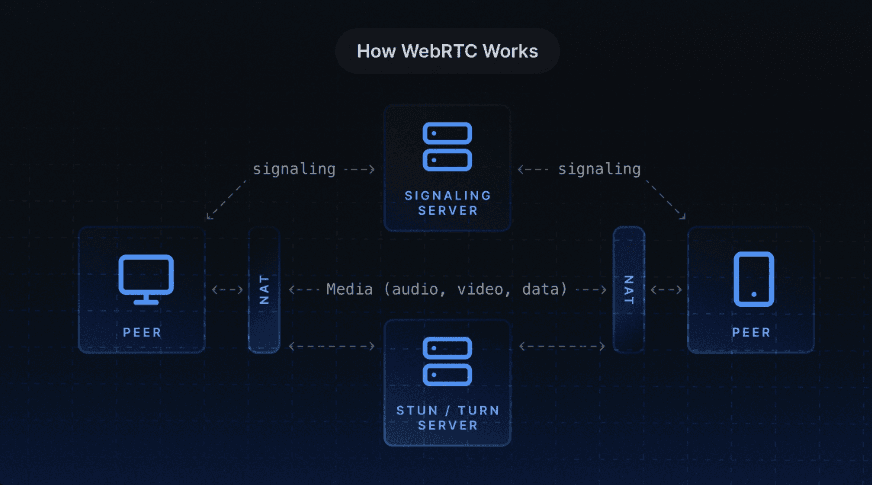
Signaling server coordinates ICE negotiation and room state. Selective Forwarding Unit (SFU) routes media streams for multi-party sessions. TURN servers provide relay fallback for restrictive networks.
Tech Stack
System Design
Signaling uses WebSocket channels for offer/answer exchange and ICE candidate trickling. The SFU selectively forwards layers based on subscriber bandwidth. Session records capture join/leave events for analytics.
Challenges
- 01Optimizing bandwidth with simulcast and adaptive bitrate strategies
- 02Managing room state consistency across distributed signaling nodes
- 03Graceful degradation when peers disconnect unexpectedly
Implementation
Client SDK abstracts peer connection lifecycle, device selection, and reconnection. Server-side health checks monitor packet loss and RTT to trigger quality tier changes.
Results
Achieved stable multi-party sessions with automatic recovery from transient network drops and measurable QoS metrics per participant.
Lessons Learned
- —WebRTC debugging requires end-to-end visibility—instrument both client and server
- —Fallback paths (TURN) are not optional for real-world deployment
- —User-perceived quality matters more than raw resolution numbers